
The ₹1.8 Lakh Crore Lesson: How Byju's Built an Empire on Borrowed Time — and What Every Young Entrepreneur Must Learn From Its Ruin
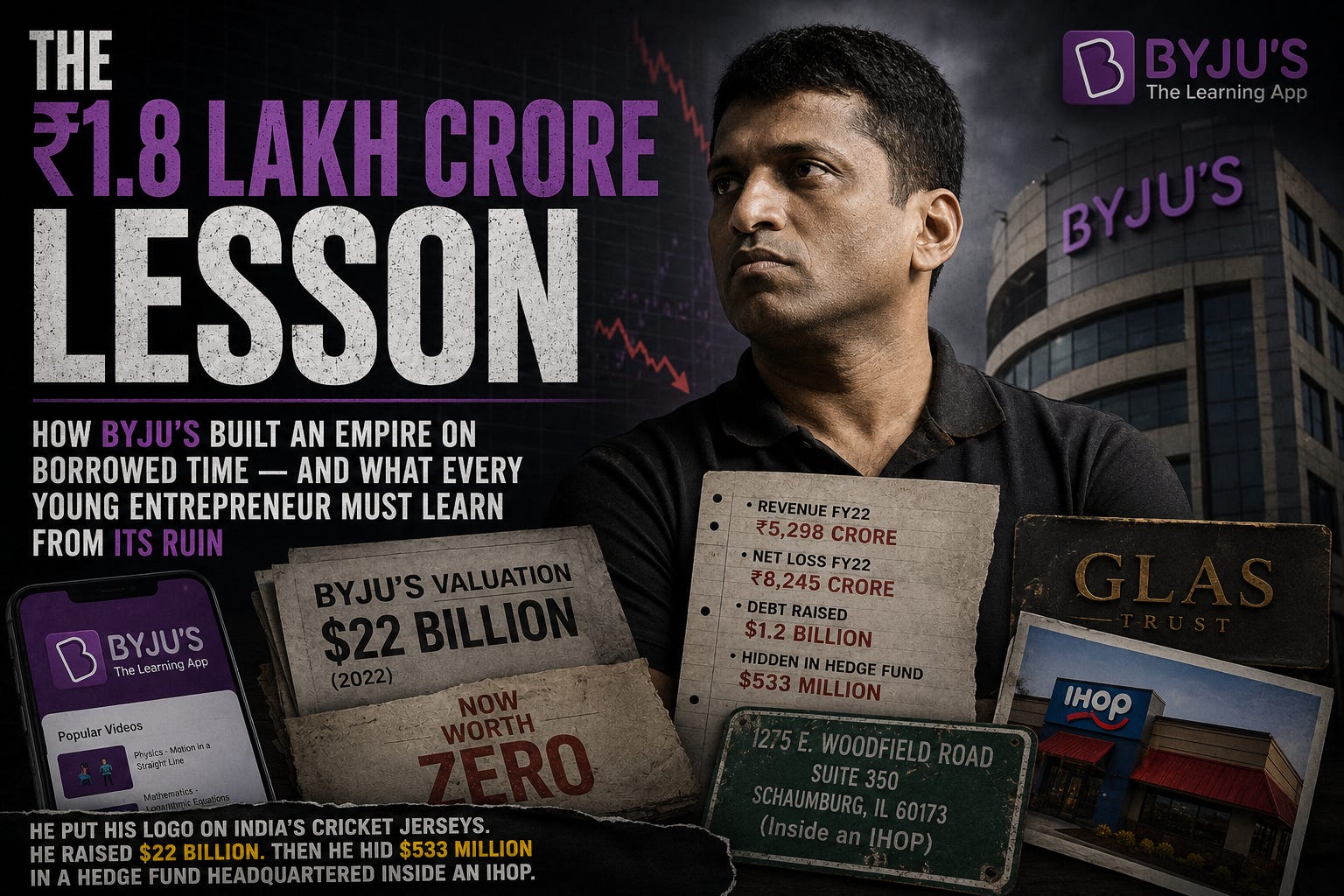
He put his logo on India's cricket jerseys. He raised $22 billion. Then he hid $533 million in a hedge fund headquartered inside an IHOP.

The story starts the way all great entrepreneurial myths do — with a nobody who outperformed everyone. Byju Raveendran grew up in Azhikode, a small coastal town in Kerala. His parents were schoolteachers. He had no startup pedigree, no IIT degree, no Silicon Valley connections. What he had was an extraordinary gift for making complex ideas feel simple and exciting.
He started by tutoring friends informally. Word spread. By the mid-2000s, he was packing 1,200-seat auditoriums in Mumbai and Delhi for CAT [Common Admission Test, the gateway exam for India’s top business schools] prep sessions. Students flew in from other cities just to attend. Teachers don’t usually become celebrities. Byju did.
In 2011, he co-founded Think & Learn Private Limited with his wife Divya Gokulnath. In 2015, they launched the Byju’s app. When COVID-19 locked 1.4 billion Indians indoors in 2020, the app became essential. Registrations exploded to 150 million students. Blue-chip investors — Prosus, General Atlantic, Tiger Global, Chan Zuckerberg Initiative, Peak XV Partners — wrote enormous cheques. By 2022, Byju’s carried a peak valuation of $22 billion, making it the most valuable startup in India’s history.
By late 2024, that same company’s equity was worth approximately zero.
This is not just a story about corporate failure. It is a masterclass in the financial and psychological traps that destroy even genuinely talented founders — and it contains lessons that every young entrepreneur building anything needs to understand before they raise their first rupee.
Here is the first lesson: revenue is vanity, profit is sanity, and cash flow is reality.
Byju’s numbers looked extraordinary on the surface. Revenue grew from ₹490 crore in FY2018 to ₹5,298 crore by FY2022 — a tenfold jump in four years. Investors celebrated. The press celebrated. The founder celebrated by sponsoring the Indian cricket team.
But look at the other column. Net losses went from ₹29 crore in FY2018 to ₹8,245 crore by FY2022 — a nearly 285-fold explosion in losses over the same period. In FY2021 alone, the company reportedly spent ₹22,509 crore on marketing to generate ₹24,283 crore in revenue. They were essentially paying customers almost a rupee to give them a rupee back.
This is what analysts call a broken unit economics model [unit economics refers to the revenue and costs associated with acquiring and serving a single customer]. Every new student Byju’s acquired cost more to acquire than that student would ever pay back. The only way to keep growing was to raise more money, use it to acquire more students, show higher revenue, raise more money — a cycle that only works as long as investors keep believing.
In the zero-interest-rate world of 2020-2021, they did believe. When interest rates rose globally in 2022, capital became expensive, investor patience evaporated, and the cycle broke. Every business built on momentum rather than margins faces this exact cliff edge. Byju’s just fell from a higher altitude than most.
The acquisitions tell an even more painful story.
Between 2020 and 2021, flush with investor capital and intoxicated by its own valuation, Byju’s went on a $3 billion acquisition spree. WhiteHat Jr for $300 million. Aakash Educational Services for $950 million. Epic for $500 million. Great Learning for $600 million.
The strategic logic seemed sound: dominate every segment of the education market, from children learning to code to professionals upskilling for corporate careers. Build a cradle-to-career educational empire.
The operational reality was chaos. Integrating four vastly different businesses — each with its own culture, technology stack, and customer base — while simultaneously managing a hypergrowth core product requires extraordinary managerial depth. Byju’s didn’t have it. The acquisitions were never meaningfully integrated. WhiteHat Jr, bought for $300 million, became a reputational catastrophe almost immediately, launching fabricated advertising campaigns featuring a fictional child prodigy named “Wolf Gupta” who allegedly got a multi-million dollar Google job after taking their coding classes. The ASCI [Advertising Standards Council of India, the self-regulatory body for advertising in India] received over 15 complaints. The campaigns were pulled. The brand cratered.
Here is what every young entrepreneur must absorb: acquisitions amplify what already exists. If your core business is operationally sound, an acquisition can accelerate it. If your core business is structurally broken, an acquisition buries you faster. Byju’s used acquisitions to paper over fundamental weaknesses, and each one made the eventual reckoning more catastrophic.
Then came the debt — and this is where the story turns from tragedy into thriller.
To fund its acquisitions, Byju’s turned to the US debt markets. In November 2021, a Delaware-incorporated SPV [Special Purpose Vehicle — a legally separate subsidiary created to ring-fence financial risk from the parent company] called Byju’s Alpha Inc. borrowed $1.2 billion through a Term Loan B [a type of institutional loan common in leveraged finance, typically carrying floating interest rates and limited amortisation requirements]. Think & Learn, the Indian parent, stood as guarantor.
When the macroeconomic environment shifted in 2022 and Byju’s began missing reporting requirements, the lenders — represented by an agent called GLAS Trust — accelerated the loan and took control of Byju’s Alpha. They installed a professional restructuring manager, replacing Byju’s brother Riju Raveendran as director of the entity.
What they found — or rather, didn’t find — became one of the most bizarre corporate fraud investigations in recent memory.
Shortly before the lenders took control, Riju Raveendran had authorised the transfer of $533 million from Byju’s Alpha to an obscure hedge fund called Camshaft Capital Fund LP. Camshaft was managed by a 23-year-old named William C. Morton with no formal investment training. Its registered business address — filed with the US Securities and Exchange Commission — turned out to be an IHOP pancake restaurant in Miami’s Little Havana neighbourhood, flanked by a car wash and a massage parlour. When journalists visited, IHOP employees had never heard of Morton, Camshaft, or Byju’s.
Later court proceedings would allege that the money moved from Camshaft through a UK procurement firm called OCI Limited, then toward an entity connected to Revere Securities, with the alleged ultimate destination being Byju’s Global Pte Ltd in Singapore — a company solely controlled by Byju Raveendran himself. The allegation: the founders were attempting to round-trip [round-tripping refers to moving money through a circular chain of transactions to disguise its origin or ownership] hundreds of millions of dollars of corporate assets back to personal control.
When confronted, Byju Raveendran allegedly told a senior GLAS Trust advisor: “The money is someplace the lenders will never find it.”
The Delaware Bankruptcy Court, unmoved by his subsequent counter-claims of lender conspiracy and FCPA [Foreign Corrupt Practices Act — a US law prohibiting bribery of foreign government officials] violations, issued a default judgment holding him personally liable for over $1.07 billion.
The lesson for founders is blunt and non-negotiable: when you borrow money, you are not borrowing from faceless institutions — you are borrowing from people who have legal systems, international courts, and enormous patience on their side. There is no jurisdiction complex enough, no SPV structure clever enough, to permanently outrun a creditor with $1.2 billion at stake.
Meanwhile, back home, the empire was dissolving from within.
Deloitte resigned as auditor in 2023, citing the company’s failure to provide basic financial records for FY2022 — an 18-month delay that is, in practical terms, inexplicable for a company of this scale. Peak XV Partners, Prosus, and the Chan Zuckerberg Initiative resigned from the board simultaneously, citing governance breakdown. By early 2024, Byju’s was unable to meet payroll.
Raveendran’s response was a rights issue [a fundraising mechanism where existing shareholders are offered new shares, usually at a discount] priced at ₹220-250 million — a 99% discount to the peak $22 billion valuation. This was not generosity. It was a cramdown [a tactic in distressed finance where new shares are issued at a steep discount, massively diluting shareholders who cannot or will not invest fresh capital], designed to obliterate the equity of any investor who refused to put in more money. Prosus, which had invested ₹4,800 crore into Byju’s, wrote down its entire stake to zero — formally acknowledging that their investment had evaporated entirely.
The Board of Control for Cricket in India then filed an insolvency petition over ₹158.9 crore in unpaid jersey-sponsorship dues — a sum that, against the backdrop of a $22 billion company, is almost comically small. The NCLT [National Company Law Tribunal, India’s dedicated corporate law court] admitted the petition and initiated formal insolvency proceedings. The Supreme Court of India subsequently delivered a landmark ruling reinforcing that once insolvency proceedings begin, they belong to all creditors collectively — no private settlement between a founder and a single creditor can bypass the process.
So what does all of this mean for you — the person reading this at the start of your own journey?
Byju Raveendran was genuinely talented. His ability to teach, communicate, and inspire is real. The early Byju’s app genuinely helped millions of students. The foundation was authentic. What destroyed the company was not a lack of talent or even a lack of vision — it was the systematic prioritisation of the appearance of growth over the reality of it.
Marketing spend that exceeds revenue is not aggressive growth — it is a slow-motion implosion with a delayed fuse. Acquisitions that you cannot integrate are not assets — they are liabilities wearing disguises. Debt borrowed to fund losses is not leverage — it is a timer. And corporate governance failures that begin as inconveniences compound, silently, until they become existential.
The single most important financial concept this story teaches is the difference between enterprise value and intrinsic value. Byju’s enterprise value [the total market value of a company, including equity and debt] at $22 billion was a collective hallucination sustained by investor optimism and low interest rates. Its intrinsic value [the actual value of a company’s assets and cash-generating ability, independent of market sentiment] was negative — it was destroying more value than it created every single year.
Build companies with real intrinsic value. Understand your unit economics before you scale. Know exactly where every rupee is going and why. Treat governance not as a compliance burden but as the architecture of trust that makes everything else possible. And remember: the lenders, the courts, and the creditors will always — eventually — find the money.
The insolvency proceedings for Think & Learn Private Limited continue across courts in Bengaluru, Delaware, and Singapore. The final creditor recovery, and the final chapter of this story, are yet to be written.