
The ₹691 Crore Beverage Company That Only Existed on Paper
How a mango-drink maker faked its way to becoming a fraud that fooled Deloitte, distributors, and Dalal Street — and the one number that was screaming the truth the whole time

The Resignation Nobody Explained
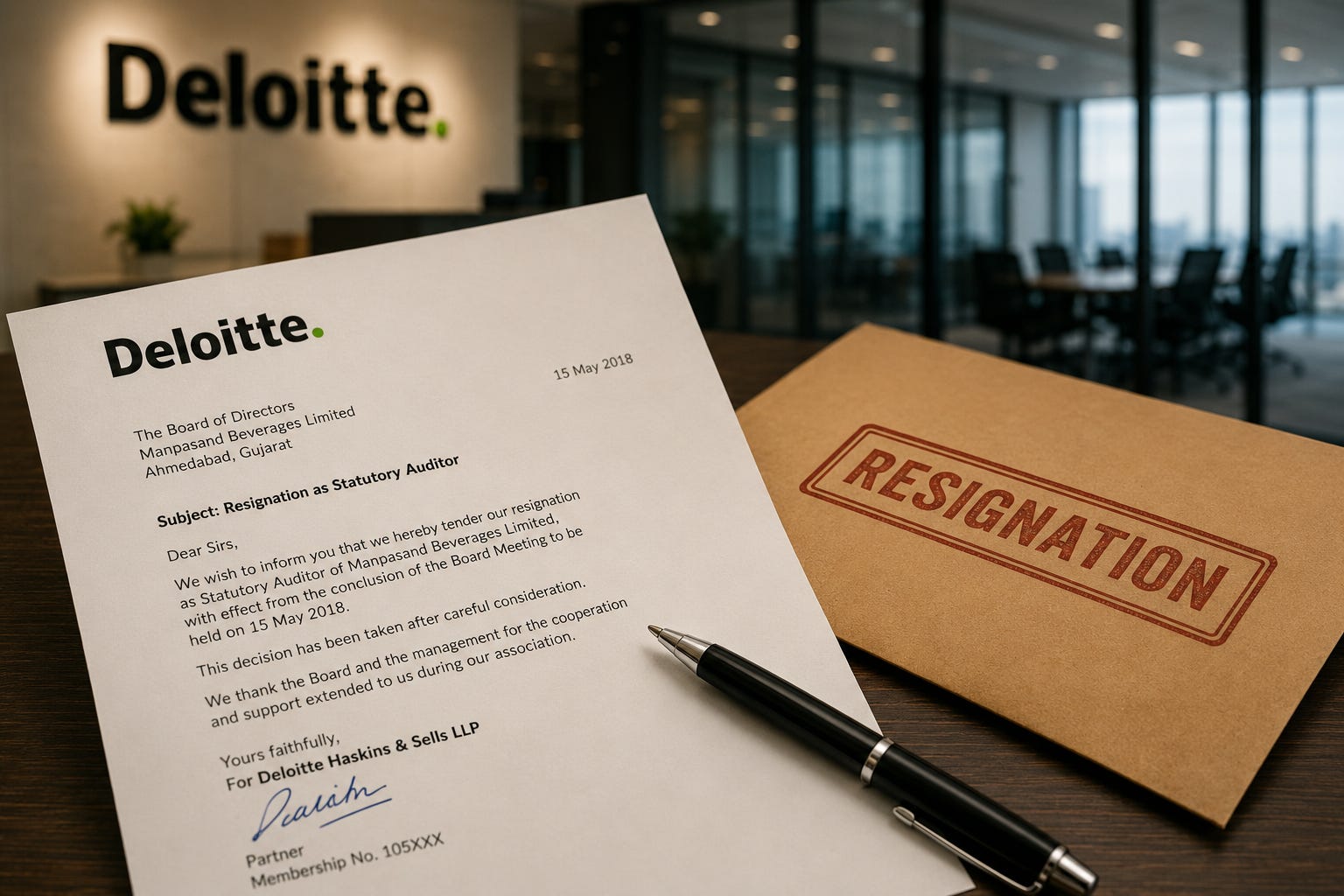
In May 2018, Deloitte quietly resigned as auditor to a Gujarat-based beverage maker best known for a mango drink called Mango Sip. No scandal had broken yet. No arrests, no SEBI order, no headlines. Just one of India's Big Four walking away from a listed client, mid-relationship, without much explanation. If you were an investor watching that company's stock at the time, you'd have had almost nothing to go on — except a single number sitting quietly in the annual report, one almost nobody was checking.
38 Companies, Zero of Them Real
A year later, the real story surfaced: officials investigating a GST fraud worth ₹40 crore raided the company's premises and discovered something far stranger than tax evasion. The company, Manpasand Beverages, had built 38 fake companies — paper firms that existed only on registration documents — and used them to sell to itself and buy from itself. It generated fake "purchases" worth roughly ₹188 crore and fake "sales" worth roughly ₹691 crore, all moving between shell entities that produced nothing, employed nobody, and sold nothing to a single real customer. As one portfolio manager put it afterward: the company existed only on the stock market, not in the real world.
Here's the uncomfortable part. This wasn't a hidden crime buried in some backroom ledger. It was sitting in plain sight, in the same financial statements every investor had access to, years before Deloitte walked out the door. To understand how a fraud this brazen hides inside numbers that look completely routine, you first need to understand the accounting rule it's built on top of — because the rule itself isn't the villain. It's one of the most sensible ideas in all of finance. It's just also one of the easiest to weaponise.
Why "When You Earned It" Is Its Own Financial Question
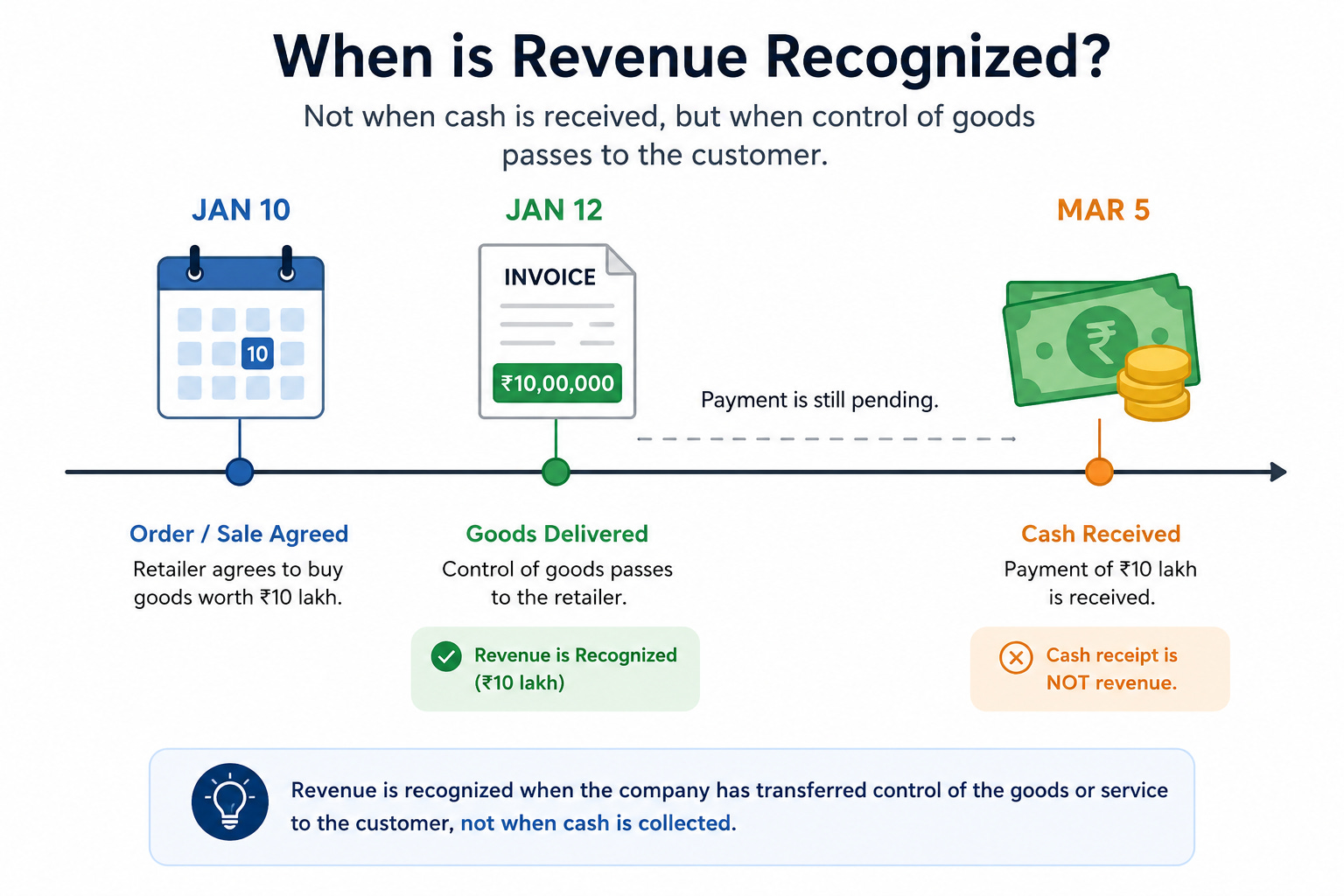
Say you run a small distribution business. In January, a retailer agrees to buy ₹10 lakh worth of goods from you, but the payment only clears in March. So when did you actually make that ₹10 lakh — in January, when the deal was struck, or in March, when the cash landed? This sounds like a technicality, but get this timing wrong across a few thousand transactions and a company's entire year can look far more, or far less, profitable than it really was. This is the exact problem revenue recognition was built to solve: it's the accounting principle that decides the precise moment a sale counts as "earned," generally when control of the goods or service has genuinely passed to the customer — not simply when a cheque clears or an invoice gets raised. Revenue is the first number anyone looks at when judging a company, which means the rule that governs when revenue shows up is quietly one of the most powerful tools in finance. Whoever controls the timing controls the story.
What the Rule Was Actually Built to Protect
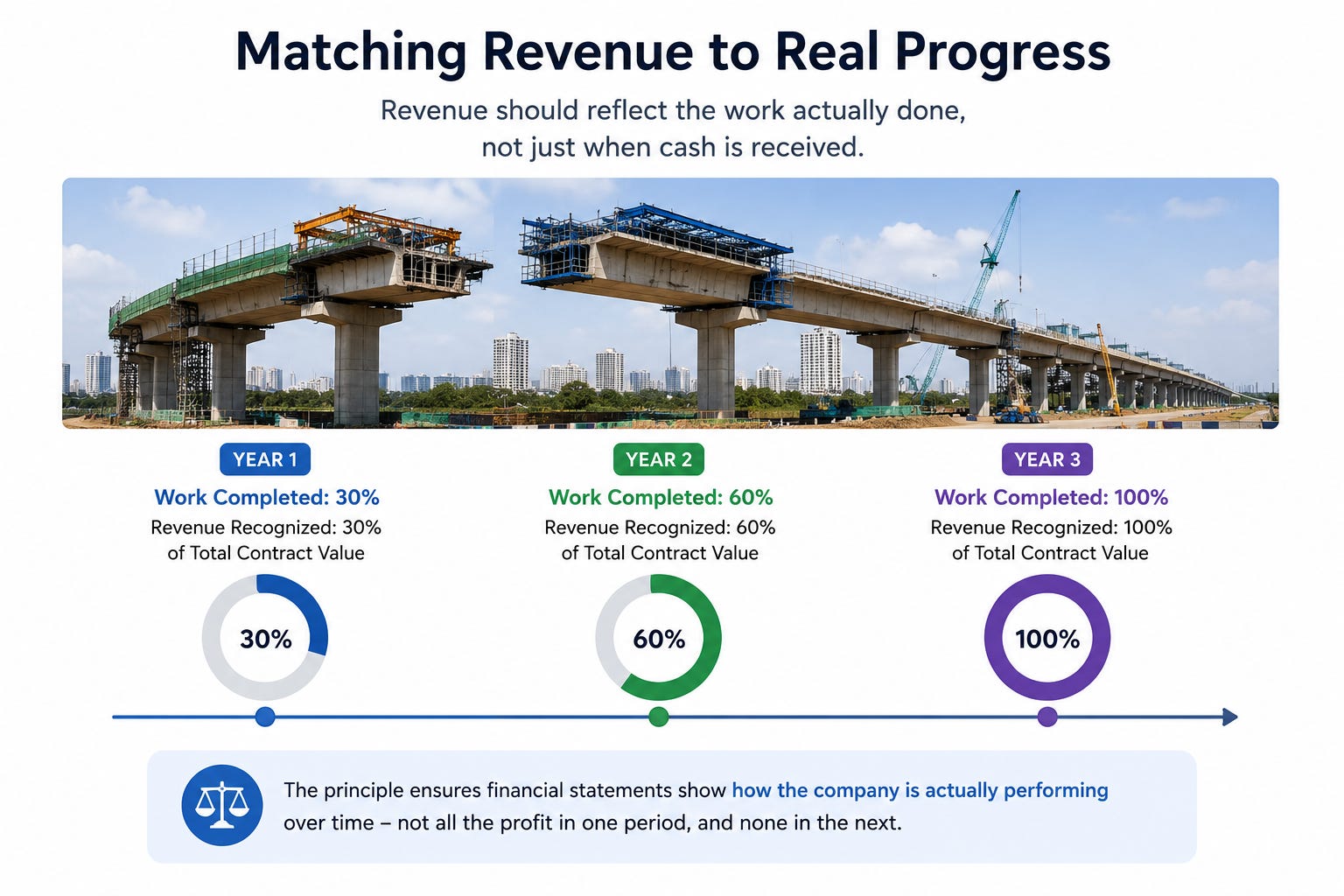
Used honestly, this principle keeps a company's reported numbers tethered to reality. A software company selling a two-year subscription shouldn't book all that revenue on day one — it should spread it across the two years the customer actually uses the product. A construction firm building a flyover over three years shouldn't wait until year three to show any revenue at all; it should recognise progress as the work actually happens. The whole point is to make sure what a company reports tracks what a company is actually doing, so the market can trust the story it's being told.
The Trick Hiding Inside the Rule
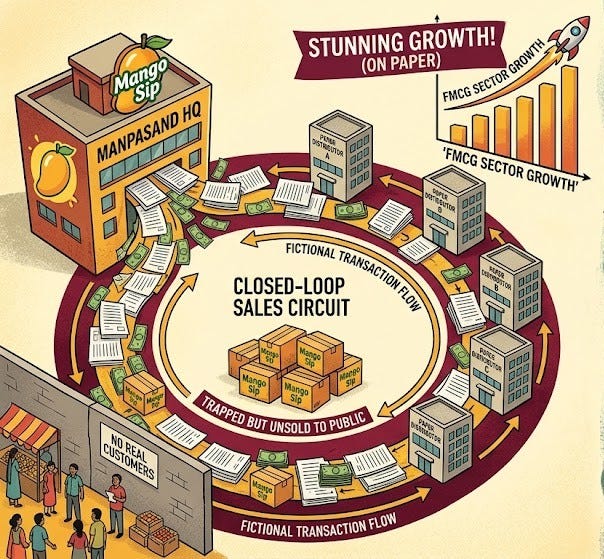
The version of this trick used by Manpasand — and by dozens of companies before it, from Bristol-Myers Squibb to Symbol Technologies to McAfee abroad — is called channel stuffing, sometimes called trade loading. Here's the mechanic in its simplest form: instead of waiting for genuine customer demand, a company pushes far more inventory onto distributors than the market can actually absorb, then books the entire batch as revenue the moment it leaves the warehouse, because technically, "control" of the goods has passed. Nothing about this looks unusual on paper. Trucks moved, invoices were raised, someone signed for the delivery. But no real end-consumer ever asked for that much product — the company has simply borrowed next quarter's sales and dressed them up as this quarter's growth. To keep distributors playing along, companies sweeten the deal: steep discounts, generous payment terms, or in the more brazen cases, a quiet side promise that anything unsold can be returned — an arrangement that breaches accounting standards the moment it's undisclosed, because the "sale" was never really final.
Manpasand took this one step further than most. It didn't need real distributors sitting on unsold Mango Sip bottles — it built the distributors itself, on paper, and had them "buy" from the company in a closed loop that never touched a real customer. The result was a growth story that looked, from the outside, indistinguishable from a genuinely thriving FMCG business — until the GST raid pulled the thread.
Why Companies Do This to Themselves
Why do companies do this to themselves? Almost always the same story: a listed company under pressure to hit a growth number Dalal Street is expecting, a management team with bonuses tied to the topline, a stock price that needs one more good quarter to justify its valuation. The tragedy is that channel stuffing never generates a single rupee of real demand — it only steals demand from the future. Next quarter, the distributor (real or fake) is sitting on unsold inventory, so fresh orders shrink, and the company either stuffs the channel even harder to hide the last round, or the scheme collapses under the weight of unpaid receivables. Manpasand's version of this collapse just happened to be more spectacular, because there were no real customers left to eventually stop paying — the whole structure was fiction from the start.
The One Number That Was Screaming the Whole Time
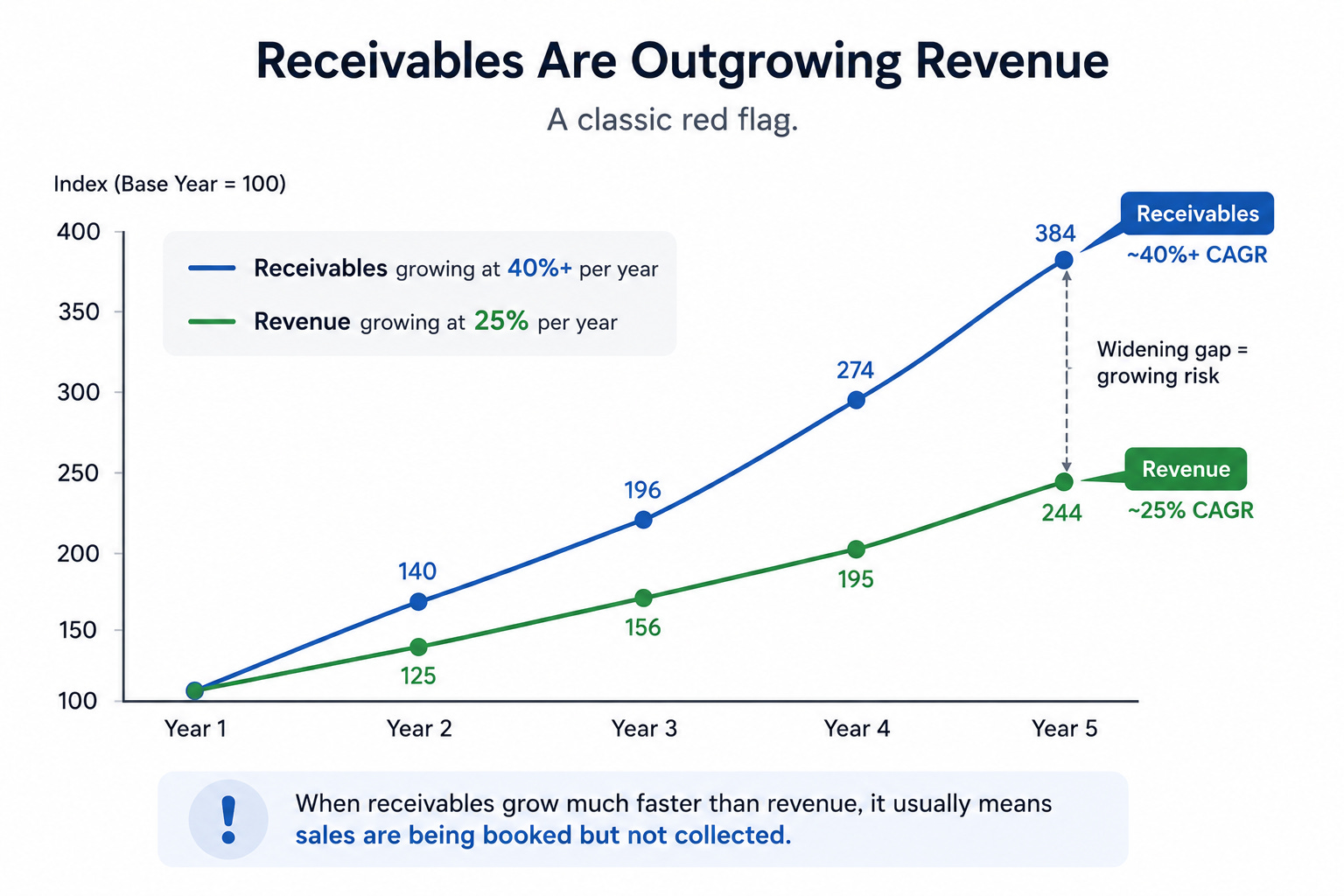
Here's what makes this case genuinely useful, rather than just a wild headline. In the years before Deloitte's resignation, Manpasand's trade receivables — money owed to the company for goods already "sold" — were growing at over 40% a year, while revenue itself was growing at only around 25%. That gap is one of the most reliable tells in all of forensic accounting: a company claiming to sell more and more, while collecting proportionally less and less cash for it, is usually a company booking sales that were never real to begin with. You don't need a forensic accounting degree to check this. It's a single ratio — receivables growth versus revenue growth — sitting quietly in every annual report, available to anyone willing to look for it instead of just trusting the headline growth number.
Why This Should Change How You Read a Growth Story
Channel stuffing exists on a spectrum, and not every instance is fraud — a genuine year-end discount to move inventory is normal business. The line gets crossed the moment side agreements guarantee returns, management hides the practice from its own board and auditors, or the stated revenue simply doesn't reflect real, durable customer demand. What Manpasand teaches you isn't "don't trust FMCG companies" — plenty of them are perfectly honest. It's that revenue is a claim, not a fact, and claims can be checked against how the cash actually behaves. Receivables outpacing revenue, an auditor leaving mid-term without a tidy explanation, unusually large quarter-end sales spikes — none of these prove fraud on their own, but together they're exactly the pattern that should make you stop and dig before you believe a growth story at face value.
What's a growth story you've been suspicious of lately — would checking the receivables-to-revenue gap have made you more confident, or less? Drop it in the comments.