
The ₹15 Lakh Crore Mirage: How Rajesh Exports Built a Trillion-Rupee Empire Out of Thin Air
For CA and finance students — because the biggest frauds aren't in the numbers, they're in what's hidden between them.

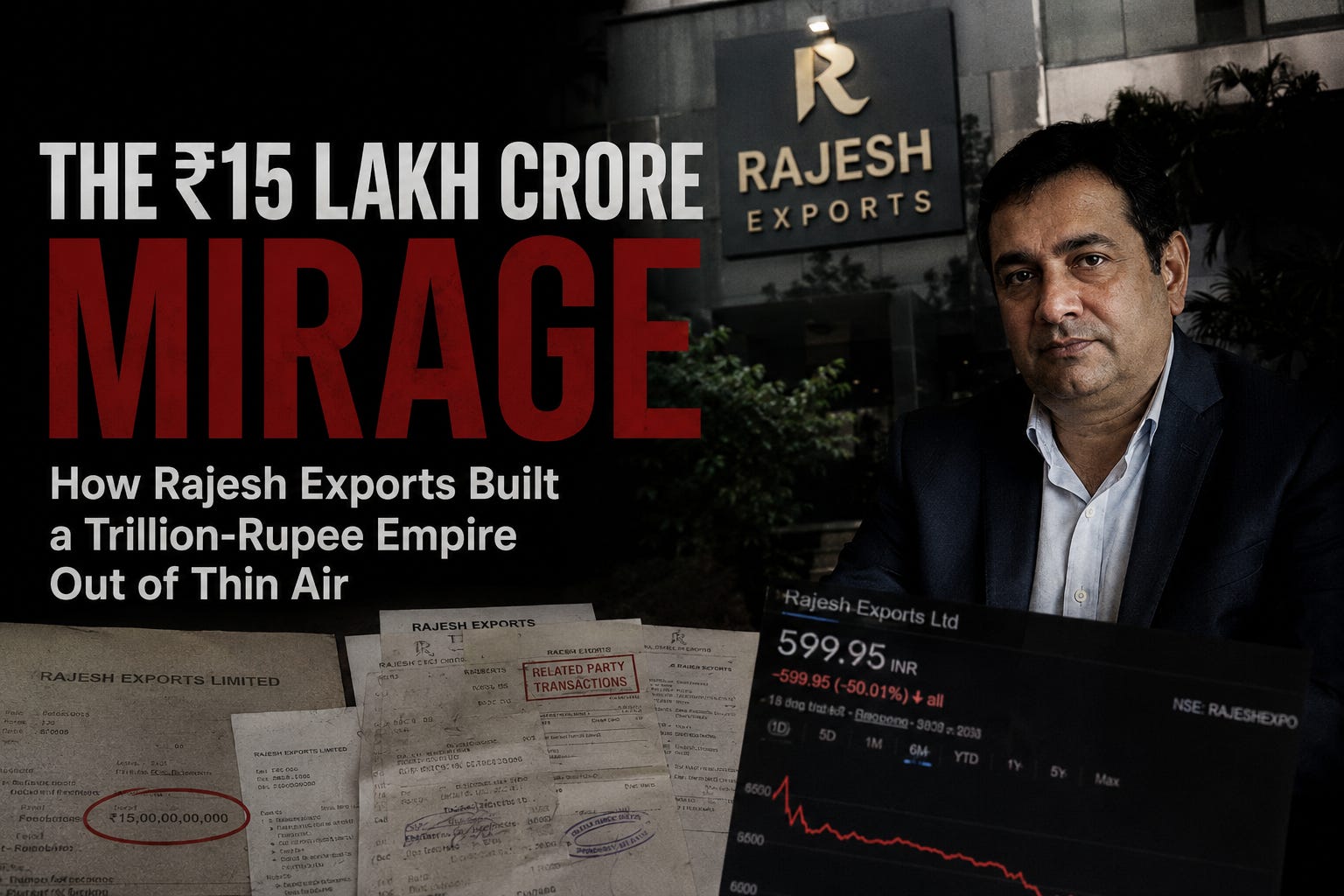
Imagine a company that claims to process 35% of the world’s gold, sits on the Fortune Global 500 list, and reports revenues that rival the GDP of small nations — yet can’t repay a ₹2,458 crore bank loan and, after years of holding a major government manufacturing contract, has built exactly one boundary wall and a shed.
That’s Rajesh Exports Limited. And in June 2026, it all came apart.
A Garage to a Global Giant
Rajesh and Prashant Mehta started REL in 1989 as a ten-person workshop in a Bengaluru garage. By 1995 they had incorporated and launched an IPO (Initial Public Offering — raising money from the public by listing shares on a stock exchange). They scaled quickly through smart manufacturing — adopting CNC technology that reduced gold wastage to under 0.01% — and built major export relationships across Dubai, the Gulf, Singapore, and the US.
The game-changer came in July 2015 when REL acquired Valcambi SA, a legendary Swiss gold refinery with 1,600 tonnes of annual capacity, for $400 million cash. This gave REL a claim to processing nearly 35% of global gold flow. What it also gave them, as it turned out, was the perfect corporate veil. Valcambi was owned through a layered chain — REL India → REL Singapore → Global Gold Refineries AG (GGR, Switzerland) → European Gold Refineries → Valcambi SA. Five entities across three jurisdictions. That structure wasn’t just complex — it was weaponised.
The Red Flag Nobody Acted On
Here’s the detail that should’ve set alarm bells ringing years earlier. In November 2020, Canara Bank classified REL as an NPA (Non-Performing Asset) — banking shorthand for a borrower who has stopped repaying. REL owed the bank ₹2,458 crore, making it Canara Bank’s tenth-largest corporate defaulter.
A company claiming trillions in revenue couldn’t service ₹2,458 crore in debt. That gap between reported profits and actual cash flows is the oldest fraud signal in the book. Canara Bank issued notices under the SARFAESI Act, 2002 (a law allowing banks to seize assets for loan recovery without a court order) and filed recovery suits at the DRT (Debt Recovery Tribunal) — a specialised court for large bank loan disputes. In a brazen counter-move, REL filed a ₹20,456 crore counter-claim against the bank. The DRT dismissed it in 2023, noting REL had submitted fake bills and diverted funds overseas through Valcambi.
SEBI Steps In — and Finds a ₹15.15 Lakh Crore Gap
In March 2024, a whistleblower complaint from an REL shareholder flagged massive trade receivables (money owed by customers sitting uncollected for suspiciously long periods) to SEBI — India’s stock market regulator. SEBI commissioned a forensic audit (an independent financial investigation intended for use in legal proceedings) by BDO India, covering FY21–FY24.
On June 3, 2026, SEBI issued a 109-page interim ex-parte order (an urgent order passed without first hearing the other side). What it found was staggering.
Valcambi’s audited Swiss accounts showed only processing income — the fees it earned for refining other clients’ gold. Between FY21 and FY25, Valcambi’s legitimate revenue translated to roughly ₹3,027 crore. Yet REL attributed ₹15.18 lakh crore to its overseas subsidiaries over that same period. The gap: ₹15.15 lakh crore — 99.80% of all claimed subsidiary revenue was fictitious.
The mechanism was a consolidation sleight of hand. Under Ind AS 110 (the Indian Accounting Standard governing Consolidated Financial Statements), a parent company must eliminate all intra-group transactions when preparing group accounts — you can’t show internal transfers as external revenue. REL bypassed Valcambi’s audited accounts entirely and instead consolidated the unaudited gross figures of the intermediate holding company GGR, effectively booking the full value of all gold physically passing through the refinery as REL’s own sales. Think of it as a laundry claiming ownership of every garment it cleaned.
When the forensic auditor asked for customer-wise sales data and debtor details, REL refused — citing Swiss Federal Data Protection laws. SEBI rejected this outright: a publicly listed Indian company cannot use a foreign privacy statute to dodge its domestic regulator. The documentation REL did provide was riddled with partially visible narrations and missing account names. Out of a ₹7,021 crore transaction sample, REL provided complete documentation for just 2.03% of the value.
The Personal Gambling, Booked as Corporate Sales
The domestic fraud was just as brazen. Between FY22 and FY24, REL recorded ₹11,486.60 crore in sales and ₹11,488.42 crore in purchases with a stockbroker called Affluence Shares and Stocks Pvt. Ltd. When SEBI questioned Affluence directly, the firm denied any such transactions ever took place.
What was actually happening: these entries matched gold derivative trades (speculative financial bets on gold price movements, not physical gold) executed by Chairman Rajesh Mehta through his personal trading account. When he incurred losses, the funds cycled back into REL, and the entire trading volume was booked as corporate physical sales and purchases. The near-perfect symmetry — ₹11,486 crore out, ₹11,488 crore in — is the giveaway. There was zero commercial activity. This violates SEBI’s PFUTP Regulations, 2003 (Prohibition of Fraudulent and Unfair Trade Practices), which ban disseminating false financial statements to manipulate investor perception.
Siphoning the Treasury and the EV Battery Charade
SEBI also traced direct fund transfers from REL’s corporate accounts — ₹338.90 crore to Rajesh Mehta personally, ₹21.25 crore to Siddharth Mehta, and ₹565.88 crore to Elest Private Limited — totalling roughly ₹926 crore, all without board approvals or related-party disclosures required under SEBI LODR Regulations, 2015 (the listing rules that mandate transparency for shareholders).
Meanwhile, REL had secured a 5 GWh mandate under the government’s PLI (Production Linked Incentive) scheme for EV battery manufacturing. Industry benchmarks suggest 1.4 GWh alone requires ~₹1,200 crore in investment. REL had invested ₹262 crore. Ministry inspectors visiting the proposed Hubli facility found a boundary wall and a shed. Inside the battery SPV (Special Purpose Vehicle — a subsidiary created for a specific project), funds were circling: Elest put ₹147 crore in, ACC Energy sent ₹112 crore back on the same day. The MD and CFO admitted in depositions they had no idea these transactions had occurred.
The History REL Would Rather You Forget
This wasn’t a first offence. In 2013, the DRI (Directorate of Revenue Intelligence) caught an REL employee smuggling gold at a railway station. Investigations found REL was importing 1.2 tonnes of duty-free gold monthly into its Cochin SEZ (Special Economic Zone — where imports are duty-free, strictly for value addition and re-export), then diverting most of it into the domestic market without paying customs duty. When DRI raided the facility, they found no meaningful manufacturing infrastructure. This is a non-bailable offence under Sections 104 and 135 of the Customs Act, 1962. The Kerala High Court denied bail to the promoters.
Despite all of this, the company kept attracting institutional capital and government contracts.
The Fallout
REL’s stock fell ~26% in six trading sessions following the SEBI order. Over three years, it has erased more than 80% of its market capitalisation, locking in over 1.94 lakh retail investors. On June 23, 2026, the ED (Enforcement Directorate — which investigates money laundering and foreign exchange crimes) raided nine premises under FEMA, 1999 (Foreign Exchange Management Act), probing $20 million in alleged capital flight and a 40% mismatch between physical gold inventory and declared books. NFRA (National Financial Reporting Authority — India’s audit watchdog) simultaneously launched a probe into REL’s statutory auditors for signing off on statements that contradicted Valcambi’s own audited accounts.
The most politically charged fallout: LIC held a 10.80% stake in REL as of March 2026. The value of that stake nearly halved in weeks — in a company that had been an NPA since 2020. Foreign institutional investors had been quietly exiting for years, reducing from 17.60% in 2023 to 14.26% by 2026. The smart money read the room. LIC didn’t.
What This Case Teaches You
Cash flow never lies — REL reported trillions in revenue while defaulting on a few thousand crore in bank debt. That gap is always the first place to look. Consolidation standards like Ind AS 110 aren’t procedural checklists; they exist precisely to prevent a parent from inflating group revenues by consolidating intermediate holding companies instead of actual audited subsidiary accounts. Auditors who sign off without reconciling group financials against subsidiary standalone audits face serious professional and legal consequences under the Companies Act, 2013 and ICAI standards. And related-party transactions without board approvals and LODR disclosures aren’t just sloppy governance — they are, in SEBI’s view, prima facie fraud.
The Rajesh Exports case is ultimately about information asymmetry — using Swiss privacy laws, multi-jurisdictional holding structures, and the naturally high-volume nature of the gold trade to make trillion-rupee fiction look like legitimate commerce. The system had enough red flags: an NPA since 2020, a 2013 smuggling case, unverifiable overseas revenues, receivables settled through undocumented offsets.
The mirror was always there. Nobody checked it.
Sources: SEBI Interim Ex-Parte Order, June 3, 2026; BDO India Forensic Audit Report; DRT Chennai judgments; Ministry of Heavy Industries records; ED operations, June 23, 2026.